Tuesday, December 9, 2008

Real estate: Where to buy now in Canada

by Duncan Hood, Moneysense
Thursday, June 19, 2008
provided by

Real estate agents like to tell you that what matters is location, location, location. They're partly right. But what also matters is timing, timing, timing. Every city moves to its own economic rhythms. Smart real estate investing is a matter of knowing when to jump into the market and when to stay out.

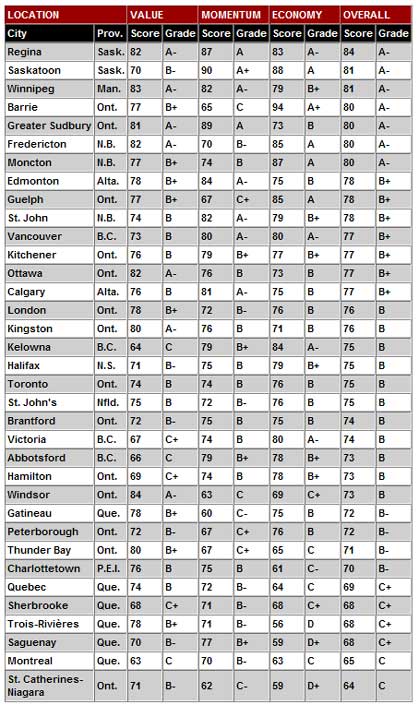
How do you know when the time is ripe? Rather than relying upon gut feel, we decided to take a more scientific approach to the question. We compiled data on the 35 major markets tracked by Canada Mortgage and Housing Corp. We analyzed each market in three different ways — by Value, by Momentum, and by Economic Strength. We assigned each market a letter grade in each of the three categories, then combined all that info into one overall grade. We awarded an A to the top 20% of cities. Average prospects had to make do with a B, while lacklustre prospects were handed a C or worse.

Many individual factors went into each grade. To calculate Value, for instance, we began by comparing average rents to average home prices, since we figured that the most basic indicator of a home's value is how much rent it can put in your pocket. High rents indicate that, if you were hit by a financial crisis, you could rent out your home for a reasonable sum. Even if you never plan to rent out your home that is still a comforting thought.

To help us gain an even better sense of a city's Value, we looked at local wages and figured out the number of years of average household income that it would take to purchase the typical local home. We downgraded communities where local residents couldn't afford to buy homes easily; we gave highest marks to cities where they could. Our reasoning was that places where homes are affordable are places where real estate prices are solidly rooted in economic fundamentals and are therefore unlikely to plunge. The differences between communities can be huge. In Regina, a typical family needs two-and-a-half years of income to buy a home; in Vancouver, a typical family needs nearly eight years of income. Talking strictly in terms of bang for buck, Regina is a much better place to buy.

But, of course, Value isn't everything. Some cities have enjoyed surging real estate markets for reasons that have little to do with local rents or typical wages. Some of these red-hot markets are cities that have lured outsiders with their natural beauty (think Vancouver); others are communities that have enjoyed bonanzas because of skyrocketing oil prices (that's you, Calgary).

To give these cities their due we rated each of our 35 cities on Momentum, a measure of how hot each market is. To gauge Momentum, we looked at home sales in comparison to new real estate listings — a high number of sales-to-listings indicate that homes are selling relatively quickly and market momentum is therefore high. We also looked at how much home prices in each city have gone up over the last year and over the last four years. To top things off, we considered how much rents have gone up over the past four years, since rapidly rising rents indicate a community with pent-up demand for housing. If you've been following the real estate news, it probably won't surprise you to learn that the runaway winners in our Momentum survey are Regina and Saskatoon.

The problem is that the same forces that conspire to drive up prices in a city can also turn in the opposite direction. To avoid being taken in by cities with weakening economies, we devoted our final grade to Economic Strength. We looked at how fast each community grew between 2001 and 2006 (the most recent year for which figures are available). We also factored in unemployment rates (based on 2007 data) and discretionary income levels, as well as a forecast from Canada Mortgage and Housing for unemployment in each city in 2008. The Economic Strength grades that resulted from all this number crunching held some surprises: it turns out that mighty Toronto and bustling Calgary have weaker economic outlooks than Fredericton and Barrie, Ont.

Finally, we rolled our grades for Value, Momentum and Economic Outlook into one overall grade for each community. We had no runaway winners, but we did find seven cities that deserve an A-. They're a diverse lot. At the top are three Prairie cities — Regina, Saskatoon and Winnipeg — with relatively low home prices, strong momentum and good economic prospects. Just behind is Barrie, where home prices are higher and momentum is weaker, but the economic outlook is outstanding. By comparison, Sudbury, another mid-sized Ontario city, offers better home prices and stronger momentum, but dimmer economic prospects. Finally, Fredericton and Moncton demonstrate that New Brunswick has a lot to offer bargain hunters, especially as the province’s economy shows signs of life.

Our analysis suggests you can find decent prospects in each part of Canada. We caution you, though, to use our results with care. Nobody can gauge what a city's economy will be like in 10 years. Our research, though, can help you analyze each city's current strengths. And that's a good starting point for any investor.

Go West, young investor
Three Prairie cities top our list of best places to buy now

Sunday, October 26, 2008

World markets await U.S. interest rates decision

OTTAWA -- It will be tales of two shrinking economies next week, here and in the U.S., with analysts warning it won't be pretty whether viewed from north or south of the border.

But the focus for the U.S., here and the rest of the world will be on how far the U.S. Federal Reserve will go to in cutting interest rates to revive an economy that most analysts now agree is already in a recession.

"We see the Fed as having no reason to go light on its rate cut," said Avery Shenfeld, economist at CIBC World Markets, which expects a half-point cut on Wednesday after its two-day rate review meeting.

And that's even before economists see the third quarter gross domestic product (GDP) report, which comes out Thursday. The consensus among economists is that the report will show the U.S. economy contracted at an annualized pace of 0.5%.

"Even without the latest GDP data in hand, a steady stream of grim economic data, including nine consecutive months of non-farm job losses, has made it abundantly clear that the United States is in recession," said Meny Grauman, another analyst at CIBC, which projects the shrinkage will be an even greater 0.7%. "This makes the expected drop in third quarter real GDP growth less of a surprise and more of a confirmation of an open secret."

But the big picture report on the U.S. economy will be only one of a string of bad reports out of the U.S. through the week, which analysts say will include further declines in new home sales, house prices, consumer confidence, durable goods orders, and personal income and spending.

Canadians will get the bad news about their economy Friday, with analysts expecting a Statistics Canada report on August GDP to show a 3% drop in overall industrial output.

"We look for a significant retracement in August from the surprising surge in the prior month," said Douglas Porter, economist at BMO Capital Markets, which is more pessimistic than the consensus and is projecting a 0.5% contraction in GDP during the month.

"In fact, there has been a sea of red from almost all the preliminary indicators for August," he said. "Manufacturing sales were down 3.7%, wholesale trade fell 3.3% and retail sales were down 0.3%, all pointing to a marked decline in the broader economy."

While Canada, unlike the U.S., should continue to avoid a technical recession at least through the third quarter thanks to a strong start to the quarter, Mr. Porter warned the evidence since suggests the economy will go into recession in the final quarter of the year and continue to continue to shrink through the first half of the year.

Meanwhile, there will be a continuing stream of corporate earnings reports through the week that won't likely inspire any investor confidence, including those of oilpatch giant Suncor Energy and from bacteria battered Maple Leaf Foods.

The reading of the overall mood of corporate Canada, however, will come Tuesday when Statistics Canada releases the results of its latest quarterly survey of thousands of businesses.

Export Development Canada won't likely lighten the mood with its latest global export forecast, also being released Tuesday.

Eric Beauchesne, Canwest News Service Published: Friday, October 24, 2008

Friday, October 24, 2008

Canada: Alberta poised to hit 4 million people by 2031

By MARKUS ERMISCH

CALGARY -- Estimates of Alberta's population breaching the five-million mark are almost certainly exaggerated, but the province is poised for continued growth, says the research director of the Canada West Foundation.

Robert Roach told the 1,300 delegates at the Calgary Real Estate Forum yesterday that by 2031, Alberta's population will have grown by more than 880,000 people to reach 4.14 million, most of whom will flock to the province's urban centres.

Immigration especially is a "highly urban phenomenon," he said, noting that 8.4% of international migrants arriving in Canada move to Alberta.

Calgary, however, still trails Toronto, Montreal and Vancouver as a magnet for new arrivals in Canada.

Roach didn't explain what impact the growing population will have on Calgary's real estate market, but real estate professionals, including officials from the Canada Mortgage and Housing Corporation, consistently point to shifting demographics as one of the main underpinnings of the province's housing market.

Roach said that Canada's demographic weight, together with the economic weight, is gradually shifting toward the western provinces, most notably Alberta and B.C.

"That's where the action is," he said.

Tuesday, October 21, 2008

Bank of Canada warns of slumping economy, cuts interest rate one-quarter point

By Julian Beltrame, The Canadian Press

OTTAWA - The Bank of Canada trimmed its trendsetting interest rate by a quarter percentage point Tuesday, saying Canada needs the stimulus to ward off the headwinds from a global recession.

The reduction, following a surprise 50 basis point reduction two weeks ago, drops the overnight interest rate to 2.25 per cent, a hair above the record low two per cent level reached in 2004.

But the bank's failure to chop by at least half-a-point left economists disappointed given the gloomy prospects for the Canadian economy.

"The entire statement was written in a remarkably dovish way as if to justify a 50-or 75-point cut and they fell short on execution," said Scotia Capital economist Derek Holt.

"I think they should have stepped more firmly in front of the problems ahead and cut more aggressively."

With the economy sharply slowing, Canada's central bank did hint that it may have to cut further at the next scheduled announcement in December.

Bank governor Mark Carney characterized the headwinds hitting Canada from deteriorating global conditions as "profound" and now projects the economy will only advance 0.6 per cent this year and by the same amount in 2009.

That's as close to a recession as possible without actually falling into one and sharply lower than the bank's July forecast, which was for a one per cent advance this year and relatively robust 2.3 per cent growth in 2009.

The central bank now says Canada won't emerge from the malaise until 2010, when it predicts growth will rebound to 3.4 per cent.

"The weaker outlook for global demand will increase the drag on the Canadian economy coming from exports," the bank stated.

"Lower commodity prices will also dampen the outlook, working through a deterioration in Canada's terms of trade to moderate domestic demand growth."

As well, the bank said "tightening in Canadian credit conditions in recent weeks will restrain business and housing investment."

In Toronto, the main stock index fell Tuesday as a lower crude price depressed the TSX energy sector, lower bullion prices pushed down gold stocks and most of the bank stocks fell.

The Canadian dollar was down 1.05 cents to 82.72 cents US at midmorning.

Carney surprised some observers by declaring that the U.S. is already in recession - something Washington has only hinted at - and that the global economy is heading there.

Given the gloomy outlook, labour economist Erin Weir of the United Steelworkers union said there was no reason for Carney's cautious monetary policy.

He added that the federal government has a role to play through its fiscal policy.

"The Government of Canada should rebuild the country's infrastructure, enhance employment insurance benefits, and invest more in other public priorities," he said.

"Fiscal policy can stimulate the economy regardless of whether chartered banks are willing to reduce borrowing costs or of whether households and businesses choose to borrow from them."

When the Bank of Canada cut its key rates by half a point on Oct. 8, banks initially balked at dropping their prime rate by the full amount until the federal government agreed to inject more liquidity into the system by buying up mortgages on their books.

But inter-bank funding rates have eased somewhat since and Tuesday's more modest quarter-point cut is expected to make it easier for chartered banks to follow through this time.

The central bank noted Tuesday that not all recent developments have been bad for Canada's economy.

Positive factors include the recent slide in the value of the Canadian dollar, which will make exporters more competitive in the global market, and efforts by major economies to bail out their banking sectors and stabilize financial systems.

BMO economist Michael Gregory said it may have been the uncertainty about how all the factors will impact on Canada that convinced Carney to take a more cautious approach.

But most economists said Tuesday's action increased the chances of another cut on Dec. 9, the next time the bank is scheduled to set interest rates.

The Bank of Canada's principal objective in adjusting interest rates is to keep Canada's inflation rate within a one-to-three per cent range, and as close to the two per cent target as possible.

It now says inflation has ceased to be a significant problem.

Although the consumer price index remains slightly elevated above three per cent, the bank said excess supply will bring price increases down to about one per cent by the middle of 2009 before returning to close to the target by the end of 2010.

"In line with the new outlook, some further monetary stimulus will likely be required to achieve the two per cent inflation target over the medium term," the bank said.

Saturday, October 18, 2008

U.S. jitters

Buy if you intend to stay in the home for a long time

Imran Syed, Citizen Special

Published: Saturday, October 18, 2008

Q: My wife and I are thinking about buying a larger home in Ottawa, but are concerned with the recent financial crisis in the United States.

Do you think that it will spread and do you advise holding off?

A: I'm sure if you are like most people you are concerned about the volatility in U.S. markets and the potential for it to spread across the border to Canada.

As you may be aware, this is a result of the subprime crisis in the U.S. banking sector.

The latest studies indicate that most Canadian banks would have very little, if any, exposure to subprime debt. As well, Canadian banks are very heavily regulated and subject to strict capital reserve and lending requirements. Unlike many of the U.S. banks affected, our banks generate much of their revenue through retail banking profits. Many of the U.S. banks are very active in investment banking.

So even though most of our financial institutions should not be exposed to the U.S. subprime situation, expect a fair amount of volatility as the uncertainty in the market sorts itself out.

At this stage it's hard to predict what the impact will be on residential real estate values.

One leading economist predicted a decline in real estate values, while another mentioned that in most of Canada, although real estate values are high, they are not necessarily over-inflated.

If you are buying this home as your principal residence and plan to live there for the long term, then perhaps, like your long-term stock market investments, short-term price volatility shouldn't concern you.

I do recommend that you consider other factors, including job stability and your debt service ratio before making a final decision.

This article provides general information. Please seek independent advice before implementing any of the strategies discussed.

Imran Syed CFP CFSB is an independent fee-based Certified Financial Planner and can be reached at feebasedadvisor.ca.


Dealers predicted the Bank of Canada will lower interest rates next week

By Frank Pingue

TORONTO (Reuters) - Nearly all of Canada's primary securities dealers predicted on Friday that the Bank of Canada will lower interest rates next week as the slowdown in the global economy shows little sign of easing.

Six of Canada's 12 dealers, surveyed by Reuters, forecast Canada's central bank would cut its key overnight rate by 50 basis points at the next rate-setting date on October 21. Three called for a 25-point cut, and three expect no move.

The bank's key overnight rate is now 2.50 percent.

Most dealers agree that the bank will lower its key rate by at least 50 basis points by the end of the year, but some differed on whether it would come in one 50-point cut on Tuesday or in a 25-point cut on Tuesday and then another in December.

"It's clear that some rate-cutting does need to occur and I don't see what the motivation would be to drag that out over the span of months," said Eric Lascelles, chief economics and rates strategist at TD Securities. "I think they are much better suited getting there quite quickly."

Just last week, the Bank of Canada unexpectedly cut its key interest rate by 50 basis points in a coordinated move with other central banks to help calm ailing financial markets.

But with concerns that the global economy is teetering on the verge of a recession that would cut demand for major Canadian exports such as oil, rate cuts in Canada remain firmly on the table.

"The U.S. outlook is really darkening day by day ... they are in a recession and now the question is how deep of a recession is the United States in," said Carlos Leitao, chief economist at Laurentian Bank of Canada in Montreal.

"So if the Bank of Canada is going to act, it's now. There is no point in waiting until December. Why wait? Do it now."

In the past two weeks a pair of Canadian banks have forecast the Canadian economy will slide into a recession during the first quarter of 2009 as the global financial crisis saps growth.

Seven dealers said the Bank of Canada would move to cut rates on December 9, the bank's subsequent scheduled policy announcement date. Four expected a 25-point cut, three called for a 50-point cut, and five dealers expected no move.

For the January 20 policy announcement date, 10 of the dealers expect the Bank of Canada to leave the key rate steady, while two expect a 25-point cut.

Tuesday, September 9, 2008

Calgary home prices fall 8%

Alberta slump leads decline across nation

Mario Toneguzzi, Calgary Herald

Published: Friday, August 15, 2008

Falling prices in Calgary and Edmonton are dragging down Canada's housing market, according to a report released Thursday by the Canadian Real Estate Association.

Led by declines of eight per cent in Calgary and five per cent in Edmonton, average house prices in Canada dropped 3.6 per cent overall in July compared with a year ago, according to the report.

The average national MLS residential sale price last month was $327,020, while in Calgary it was $402,788. In Edmonton, it was $335,100, said the report.

MLS sales dropped 10.9 per cent in Canada in July.

In Calgary, sales were down 13.1 per cent compared with July 2007, according to the CREA report.

"Canada's housing market is running into some seriously foul weather amid the weakest affordability in nearly two decades," wrote Douglas Porter, deputy chief economist with BMO Capital Markets Economics in a commentary on the CREA numbers.

"While we still doubt that Canada will stage an instant replay of the trauma in U.S. markets, even a mild version would be bad news."

"Mounting consumer caution" prompted the national decline in existing home sales and the "steady drum-beat of double-digit sales declines" this year is beginning to "weigh more heavily on prices," Porter wrote in his analysis.

"We opined a month ago that 'given the steep run-up in new listings, double-digit sales declines and the sharp drop in consumer sentiment, price declines may become a more common feature across the country in the months ahead.' These latest figures simply pound home that point."

Statistics by the Calgary Real Estate Board for July showed the average sale price of a single-family home in the city dropped 9.79 per cent compared to July 2007, to $456,380, while the average price of a condo decreased 6.98 per cent, to $296,338.

It is also taking longer for homes to sell. In July, the average number of days on the market for single-family homes was 52, compared with 35 a year ago. For condos, it was also 52 -- up from 33 days.

Laurie Hicks has had her home for sale in the northeast Mayland Heights neighbourhood for nearly three weeks on the WeList.com system for sale by owner. The completely renovated home, listed at $489,000, will go on the MLS market on Monday through the Re/Max real estate firm.

Considering the current market conditions, she is still confident the house will sell.

"For us, we honestly believe there are enough young professionals that want to be within five, 10 minutes of downtown. I believe the right buyer is going to walk in there and say, 'You know what, nothing has to be done to this house for 10 or 15 years,' " said Hicks, who has owned the house for more than a year.

"So, we are optimistic, but having said that, we need to have the right buyer," she said.

"We know what we could have got last year but we were a little bit unfamiliar with what happened with the housing prices until just now."

The inventory of homes for sale in Calgary has declined for two consecutive months, which is a good sign in the real estate market, but it is still "extremely high," said Ted Greenhough, with Re/Max Realty Professionals in Calgary.

"We still have a lot of inventory to work through before we're going to approach what would be called a balanced market," he said. "So, in my opinion there's still downward pressure on prices. This high inventory problem is not something we're going to work through in a month or two. I think it's a long-term problem. At the least, the market conditions will remain the same for the next several months."

Year-to-date until the end of July, existing home sales in the country are down 13 per cent from the same period a year ago. Calgary leads the country with a 30.1 per cent decrease in sales followed by Greater Vancouver at 24 per cent and Edmonton at 23 per cent.

Nationally, the average sale price is up 2.2 per cent year-to-date to $338,586.

In Calgary, the year-to-date average sale price is down by 0.1 per cent to $414,213. "The combination of a larger inventory of homes for sale and fewer home sales means less upward pressure on home prices in many markets," said Calvin Lindberg, CREA president. "The challenge for many sellers is determining the right price for today's market conditions. There is no doubt the Canadian real estate market is pulling back from the record sales and price increase levels of 2007."

Porter said, "pricing power is in full-scale retreat across many major markets."

July's year-over-year decline on a national level followed a small dip (0.4 per cent) in June, the first drop in almost a decade, said Porter.

"We downplayed June's price decline, since it was so narrowly based," he said. "However, the drop in July spread to a number of cities, including even the previously untouchable Vancouver market."

mtoneguzzi@theherald.canwest.com

Prepare for home prices to drop

Vancouver houses overvalued by 11 per cent, according to a UBC study of real estate

Derrick Penner, Vancouver Sun

Published: Tuesday, September 09, 2008

With Metro Vancouver past the peak of its current real-estate market cycle, more discussion is emerging about what the cycle's downside will look like.

The latest discussion points lean towards a price correction in the double digits, with one study showing current Vancouver house prices overvalued by 11 per cent on a particular measure and an economist observing that prices are falling at a rate of 10 per cent or more this year.

University of B.C. real-estate economist Tsur Somerville was lead author of a study that evaluated the cost to rent a detached, mid-market home in nine Canadian cities, versus the cost to own, to find a balanced price.

The study's conclusion was that in the second quarter of this year, Metro Vancouver's average house price, $754,500, was 11 per cent higher than the balance point.

However, Regina, Winnipeg, Ottawa and Montreal are 25 per cent out of equilibrium, considering prices and rents in those markets. Halifax house prices are 20 per cent out of balance.

Titled Are Canadian Housing Markets Overpriced? the study observes that housing affordability is a severe problem in some Canadian cities, limiting the ability of markets to continue to rise.

Calgary prices showed as being seven-per-cent higher than balance.

Only Toronto showed prices in balance with rents, and Edmonton, which has already seen price declines, would need to see prices climb again by eight per cent to be in balance.

"I was surprised the Vancouver number is as low as it was," Somerville, director of the centre for urban economics and real estate at the Sauder School of Business at UBC, said in an interview.

He added that the rent-versus-own measure is a narrow observation that treats homes like a financial asset and does not take other measures of affordability or valuation into account.

And what eventually happens in the Vancouver market, Somerville said, will depend on a host of variables ranging from changes in mortgage rates to changes in the long-term average appreciation of housing prices and economic conditions.

"What you can identify is where the pressures are," Somerville added. "How the market plays out is very different."

Prices do not have to fall for the market to correct, Somerville said. Prices can simply stagnate over a period of time, like Vancouver experienced through the mid-1990s until 2001.

However, Somerville added that Vancouver has built new homes at a much higher rate than household formation in the city during the up-cycle, and the inventory of unsold homes in the market has ballooned rapidly, which make Vancouver more susceptible to price declines.

"Those are two big warning signs," he said.

Somerville said another unknown in the declining market is what the buyers of pre-sale condominiums that are now under construction will do once the units are complete.

If a significant number of investor-buyers of those condominiums decide to sell them right away, that would put more downward pressure on prices.

However, at this point there is little evidence of "calamity in the housing market," said Helmut Pastrick, chief economist for Central 1 Credit Union, formerly known as Credit Union Central B.C.

Sunday, June 15, 2008

The new way to make money in real estate

The secret to successful real estate investing over the past decade has been simple: buy property, then sit back and watch it rocket up in value. With prices shooting skyward at double-digit rates in many Canadian cities, how could you not make money? Unfortunately for would-be Donald Trumps, making money over the next decade may not be quite so straightforward. A recent housing affordability report from Royal Bank proclaimed “easy money no more,” and warned that prices in both Calgary and Edmonton have “soared well above their fundamentals to unsustainable levels.” Meanwhile, the latest numbers from the Organisation for Economic Co-operation and Development say that Canadian homes are now more expensive than their U.S. counterparts, when you measure them in terms of their relationship to incomes and potential rents. Nobody is yet predicting a U.S.-style real estate collapse in Canada, but all the data suggest that the red-hot market of the past few years is likely to soon come off the boil.
If the housing market cools, the old way of real estate investing will stop working, and investors who rely on rising home prices for their profits will start losing money. Luckily, there’s another way to invest in real estate, and it works no matter what the market does.

Using this method, Dan Young made his first million by the time he was 34. He started investing in properties in his home town of Midland, Ont., when he was just 24, and made most of his money on a four-plex, a six-plex, and a 12-plex.

His secret was nothing more than a systematic method for evaluating potential investments. Rather than betting on possible gains in real estate prices, he made sure that the rent he received from a property put cash into his pocket each and every month, from the very first day he bought a property. “When things are going well, when interest rates are declining and property values are going up, then it’s really easy to look like you’re smart,” he says. “But when things go the other way, it’s really easy to lose money too. That’s why you need a long-term strategy based on some realistic expectations.”

To be honest, Young’s way of investing isn’t really all that new at all — it has just fallen out of favour over the past decade. David Southen has been using it for 24 years. He’s now 48 and he and his partners own 125 residential units in Southern Ontario worth about $7 million. He can sum up his secret in just three words: positive cash flow. “You need to be making enough from renting your property out so that after all of your expenses are paid and your contingencies are allowed for, you can pay the mortgage and still put a few shekels in your jeans,” says Southen from his London, Ont., home. “If you’re not, then it’s not a viable investment.”

If you want to generate a reliable stream of cash from your real estate investment, rather than just gamble that prices will go up in the future, Southen says you need to carefully assess each property before you buy it. Your fate as a landlord will be largely determined at the moment of purchase — pay too much and your mortgage and expenses will eat up all of your profits. Southen says there’s a simple three-step way to calculate the right price to pay for an investment property:

• First, get an honest estimate of the total income you can expect from renting it out each month

• Second, get an honest estimate of the expenses involved in running the property

• Third, figure out how much money your property will have to spin off after expenses to pay the mortgage and provide you with a profit

Once you know those three numbers, evaluating how much to pay for potential real estate investments is easy. Of course you’ll only get a trustworthy result if you use trustworthy numbers to begin with, and that’s the catch. Getting a grip on the true rental income you can expect and the true expenses associated with a property can be tough — mainly because the seller will supply you with a long list of bogus numbers. “There’s a well-known saying in real estate investing,” says Southen. “‘Trust — but verify.’ Getting a handle on the property taxes and insurance is easy. But people will lie to you about everything else.”

Sleuth out the real rents

If you want to get past the lies and figure out how much your potential investment is really worth, start by estimating the total rental income that the property can generate. Ask the seller for the “rent roll,” which tells you how much rent is being collected from each unit. Then scan the local papers to find out the typical rents being charged in your area. As a double-check, look for the rental market reports published by the Canadian Mortgage and Housing Corporation (see www.cmhc-schl.gc.ca) and find out the typical rents in your area. If the rents charged to the tenants in your building are lower than the local average, that’s good. It means there’s room to raise rents in the future. “However if the average two-bedroom is renting out for $850, and the units in your potential investment are renting out for $1,000, watch out,” says Southen. “They might be filled with the seller’s relatives, who will leave the second you close on the property. That’s an old favourite.”

Don't forget vacancies

“The vendors will tell you the property is fully rented with a waiting list, so they don’t have any vacancy or bad debt,” says Southen. “But it’s not true. Every landlord has vacancy and tenants who skip out without paying.” When calculating your expected rental income, subtract 5% from the total income the building will generate at full occupancy to offset your expected losses from vacancy and bad debt. Then add in any additional income from laundry or parking. That will give you your “gross effective income.”

Add up the small stuff

The next step is to estimate expenses. Your first big cost is property management. If you’re buying a larger property, you’ll probably want to hire a professional property manager to rent out the units, keep the books, and oversee basic maintenance. If you’re buying a smaller property, you may want to do all that yourself — but you should still subtract your time as an expense because you may not want to do the chores forever. Southen suggests you count on paying 6% of your rental income for management in larger buildings and more in smaller ones.

Then there are maintenance and repair costs. “That’s where you’ll run into the biggest fudge factors,” says Southen. “The landlord will tell you: ‘I do all the repairs myself, so there’s no cost.’” Don’t believe it. You can count on spending at least $800 a year on maintenance for each apartment or townhouse. On top of that, you should budget separately for any major capital expenses, such as replacing the roof or upgrading an elevator. Have the property professionally inspected and do an environmental audit before buying to avoid nasty surprises.

Utilities, your next expense, can be an opportunity. “If I go into a building and see that it’s stuffed full of old incandescent light bulbs, then I know right away that I can peel 10% to 20% a year off the bill just by changing the bulbs,” Southen says. Similarly, old furnaces and boilers, old toilets and leaky showerheads offer you the chance to improve your annual income from the property with a few lost-cost upgrades.

To get a good idea of what you’ll be paying for heating, water and electricity, ask for at least one year’s worth of bills. “A lot of people will say they don’t have them,” says Southen, “but utility companies will provide a summary of the previous year’s charges if the owner asks for it.”

Don’t forget the cost of advertising for new tenants. If you have a lot of units like Southen has, you can count on paying about $400 a month for newspaper ads and the like. If you have a single triplex, the expense can be negligible.

Your final three expenses — property taxes, insurance and bank charges — are usually straightforward, but Southen offers a couple of tips. With property taxes, watch out if you’re paying a lot more for the building than it was last assessed for, because the very act of purchasing it could trigger a new assessment and higher taxes. With insurance, make sure the building isn’t underinsured. If it is, be prepared to pay more for a better policy.

By now, you’re probably starting to see why inexperienced real estate investors would rather just focus on rising house prices. Getting a good grip on your true income and expenses is a lot of work, and you may feel like you’re worrying about nickels and dimes when there’s big money to be made from rising property values. But remember that you want an investment that doesn’t depend on rising home prices to make you money.

If you diligently tote up all your various costs, you’ll be astonished by what you find. Almost always, vacancies and expenses eat up a full 50% of your gross rental income, though many sellers will deny it. “Underestimating how much it’s going to cost to run a building is the No. 1 mistake made by inexperienced investors,” says Southen. And it’s the No. 1 reason why investments that look good on paper can end up costing you tens of thousands of dollars in the long run.

So what's your return?

You’re now on the home stretch to determining what your building is worth. Subtracting vacancies and expenses from your rental income will give you what’s called your “net operating income” for the property. You use that to determine the return from your property, commonly referred to as your “cap rate.” The cap rate is simply the cash yield you get from your property, after accounting for all expenses but before mortgage payments. In other words, it’s your net operating income divided by the price of the property. It has to be higher than the interest you’re paying on the mortgage or you won’t make any money. These days, Southen says he looks for cap rates between 7% and 8%. “If someone came to me with an honest 8%, I’d buy all day,” he says. “A 7.5% would be okay, but a 7% … well, I’d have to think long and hard about it if it were a 7%.”

And the true market value is…

Now that you have your cap rate, you can calculate what you should pay for your building. Just subtract the expenses from the annual rental income, then divide by the cap rate. For instance, if the building has four units renting for $900 a month each, expenses that eat up 50% of your gross income, and a cap rate of 7.5%, you can quickly calculate that you should pay about $290,000 for the building, tops. If you pay more, it’s probably not a good long-term investment.

We know what you’re thinking: “Where on earth am I going to find a four-plex that’s going for less than $300,000?” Certainly not in Vancouver, where the average detached house is now selling for north of half a million. Probably not in Toronto, Calgary or Edmonton either.

But that doesn’t mean the calculations are wrong. What it means is that now may not be a great time to buy. Your annual return is essentially the spread between market rent and the cost of buying and owning a property. In many cities, property prices have been climbing by as much as 10% a year. Rents have been edging up far less. Thus, the rising prices have squeezed the profit potential right out of the buildings.

If you’ve read books or attended seminars on buying real estate, this may surprise you. Many gurus talk up how easy it is to succeed in real estate and offer up tricks that are guaranteed to make money. They chatter about the power of leverage, the secrets of bargain basement financing, and how to identify up-and-coming neighbourhoods. All of those tactics can help you get more out of a decent investment. But none of them will help you if you pay too much for your property. It’s almost impossible to turn around a true money-loser — which is why positive cash flow is king, and all other considerations are secondary.

David Southen and Dan Young made a killing in years past because they bought when prices were lower. Southen says that since then, prices have surged too high. “I’d like to buy right now,” he says. “I’ve got lots of money available to buy with. But I’ve found that there’s really nothing to buy that’s reasonable.”

Young largely concurs. His first investment was a four-plex in the Midland area that he bought back in 1998 for just $135,000. His second investment was a six-plex that he bought in 1999 for $190,000. He’s not seeing many prices like that today. In fact, he’s been looking to buy a new property for seven years.

He thinks he may have finally found a prospect. It’s a nine-plex in Midland that he’s had his eye on for some time, although it wasn’t officially for sale. He liked it because he knew that the landlord was charging lower-than-market rents, which meant that Young could raise the rents as the tenants rolled over. Not only that, but the landlord had been paying for the utilities. Young knew that the units were separately metered, so he figured he could also download the utility expense to new tenants, who could pay their utilities directly. On the off chance he could persuade the owner to sell, Young asked his real estate agent to inquire. “The owner was interested, so I moved in fast,” he says. “Really fast.”

Young’s latest adventure shows the challenges of investing in this market. At first, the price for the property looked too high, but once Young factored in the artificially low rents and the effect of downloading the utilities, he found that the building could carry itself at a decent cap rate. “It’s really hard to find investments that make any sense right now,” he says. “But there are some. You just have to wait and persevere.”


Source: http://ca.pfinance.yahoo.com/ca_finance_general/727/the-new-way-to-make-money-in-real-estate/


Saturday, January 5, 2008

Calgary: Million buck club growing

Home sweet home has gotten a lot sweeter among the city's elite real estate.

Calgary's explosive economy has multiplied the number of city homes valued at more than $1 million by 10 since 2005 -- from 815 to 8,146.

That's according to the city's market value assessment data, released yesterday, that also showed nine neighbourhoods' median assessments exceeded $1 million with the southwest Eagle Ridge area the priciest, coming in at $1,865,000 based on July 1, 2007 figures.

And the city now counts two properties worth more than $1 billion -- downtown office complexes Bankers Hall and the Petro Canada Centre.

City assessor Stuart Dalgleish called it a good news indicator.

"It says our economy in Calgary has been really, really strong and healthy and there's continuing confidence in our economy," said Dalgleish.

Only about 4% of the change in property worth is due to the construction of pricier homes, the rest is from gains to the value of existing property, say city officials.

Eagle Ridge is also one of only two neighbourhoods -- the other being inner city Roxboro -- where homeowners can expect to swallow a tax increase of 20% or greater this year.

A rock-bottom downtown vacancy rate and huge demand for office space has fuelled the $1 billion price tags, said Amy Enfield, city assessment spokeswoman.

"It's possible Calgary has the most expensive office space in the country," she said.

While Dalgleish said the number of challenges to residential assessments hasn't increased in recent years, Ald. Ric McIver said there's a downside to the process and to some of the rise in values.

"Some people are cash-poor and property-rich and that's the problem with seniors," said McIver.

He noted the city is still determining if any residents on fixed incomes have been forced from their homes by steep tax hikes.

McIver also said the system punishes people for upgrading their homes by taxing them more "and rewards you for letting your property run down."

But Dalgleish said the system, now into its 10th year, has proven an equitable, revenue-neutral model that's being eyed by an increasing number of other jurisdictions.

"We have a good system and we have stability ... changes are more incremental than if we did the assessment less frequently," he said.

Source: http://calsun.canoe.ca/News/Alberta/2008/01/05/4753951-sun.html